
Half Time. And the Score Might Surprise You.
"Someone is sitting in the shade today because someone planted a tree a long time ago" — Warren Buffett
Something worth pausing on.
Because if you spent the first half of 2026 watching the news — the Middle East tensions, oil price swings, Federal Reserve uncertainty, tariff noise — you'd be forgiven for thinking the score at half time was pretty grim.
Guess what? It wasn't.
The S&P 500 closed out the first six months of 2026 up 9.6% — before dividends. Not a bad result for a period that had the financial media in a near-permanent state of alarm. Meanwhile, the ASX 200 has continued to grind higher, rewarding investors who stayed the course through some genuinely uncomfortable headlines.
The second quarter alone was up nearly 15% for the S&P 500. The best Q2 in a midterm year we've ever recorded. Ever. Let thank sink in.
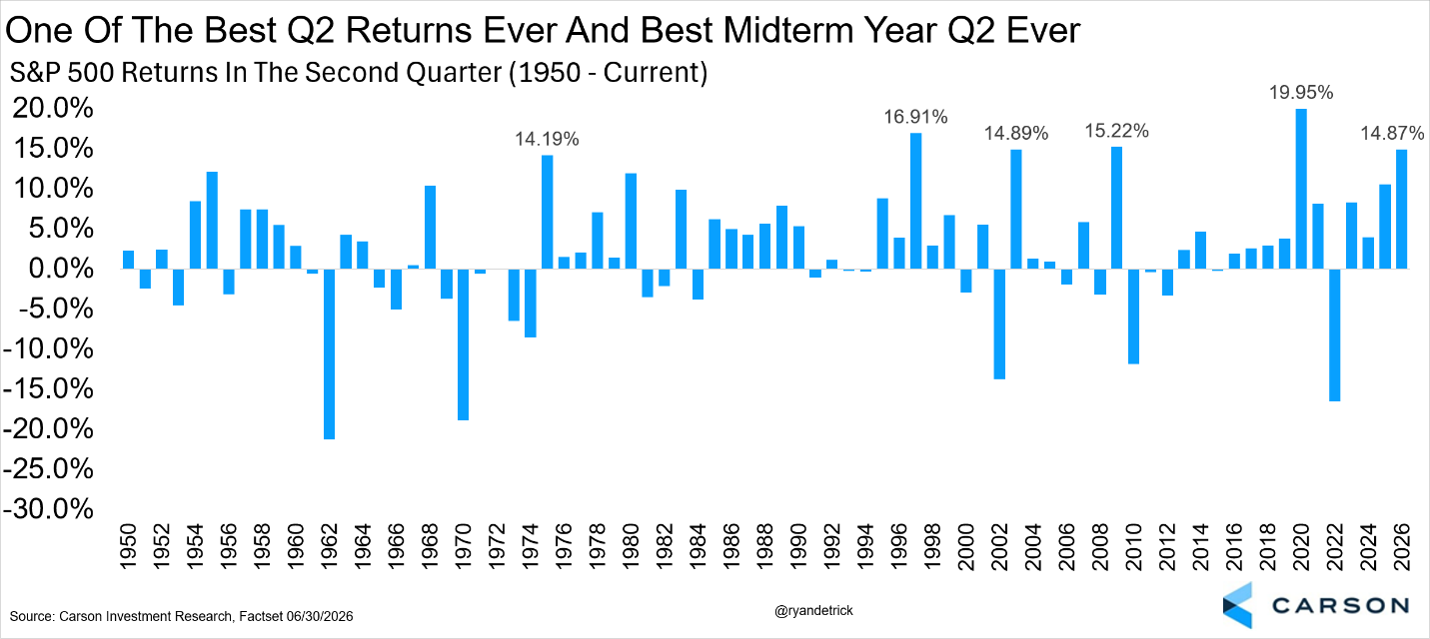
The Worry Was Read, And The Outcome Was Better.
Look, the concerns weren't imaginary. Markets did wobble in Q1 — the S&P 500 fell close to 5% to start the year. There was real uncertainty. And if your emotional response to that dip was to question everything, I understand. That's a deeply human reaction.
But here's the thing I keep coming back to: markets are not the economy, and the economy is not the headlines. The job of a long-term investor isn't to predict which quarter will be rough — it's to stay positioned so that when the recovery comes, you're already in the room.
This year, the recovery came fast and hard.
History Doesn't Repeat, But It Does Rhyme
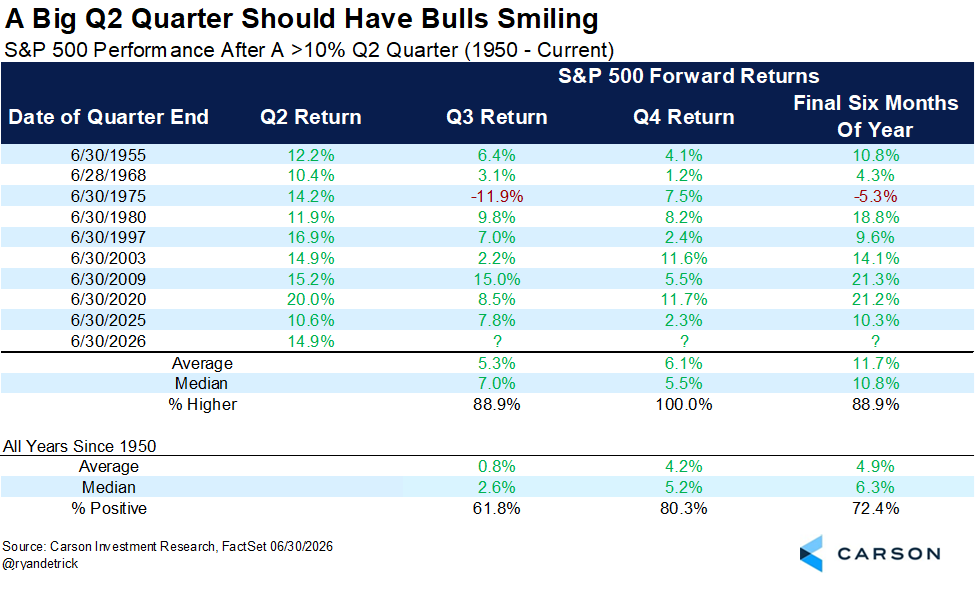
Here's something worth chewing on. When we look back at every time the S&P 500 has posted a double-digit Q2 gain — nine other occasions since 1950 — the forward numbers are striking. Q3 was lower only once. Q4 was never lower. The full second half of the year averaged a gain of 11.7%. That's more than double the typical second-half return.
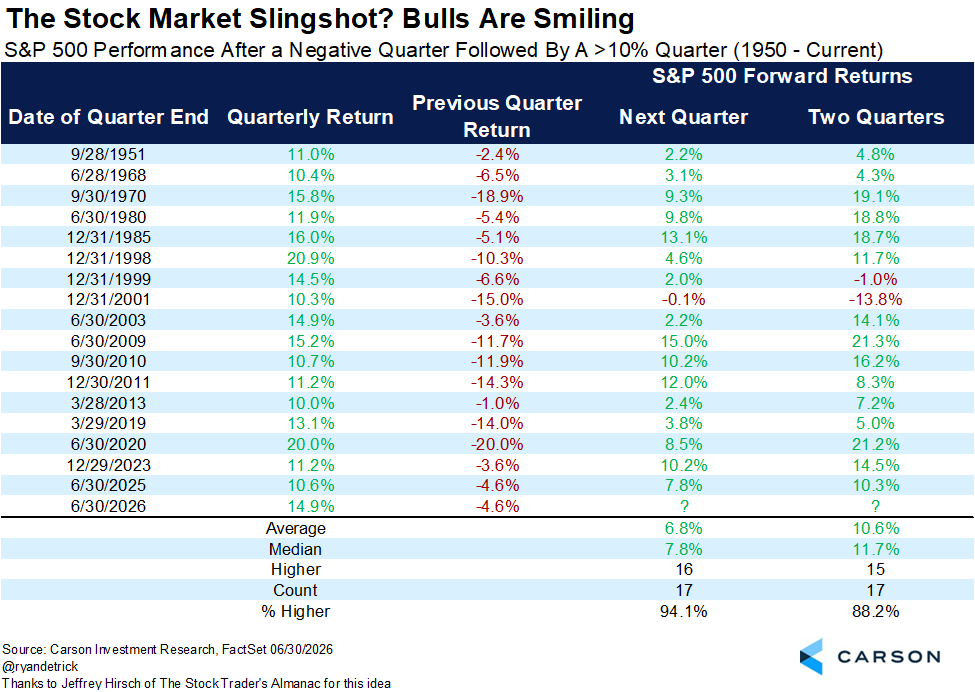
And there's another pattern worth noting — what some are calling the "slingshot" effect. When a strong quarter (10%+) immediately follows a negative one, the subsequent quarters have been positive the overwhelming majority of the time. That's precisely the setup we're in right now: down Q1, massive Q2.
None of this is a guarantee. But it's worth knowing what the data says when markets do what they've just done.
So, What Now?
I want to be clear about something: I'm not in the business of predicting markets. Nobody does that reliably, and anyone who tells you otherwise is selling something.
What I am in the business of is helping you think clearly when markets make it hard to think at all.
Here's what the evidence suggests as we move into H2 2026: when the S&P 500 is up somewhere between 5% and 10% at mid-year — which is roughly where we sit now — the second half has been positive nearly 88% of the time. The worst full-year outcome from that starting point? Flat. Not a crash. Not a collapse. Flat.
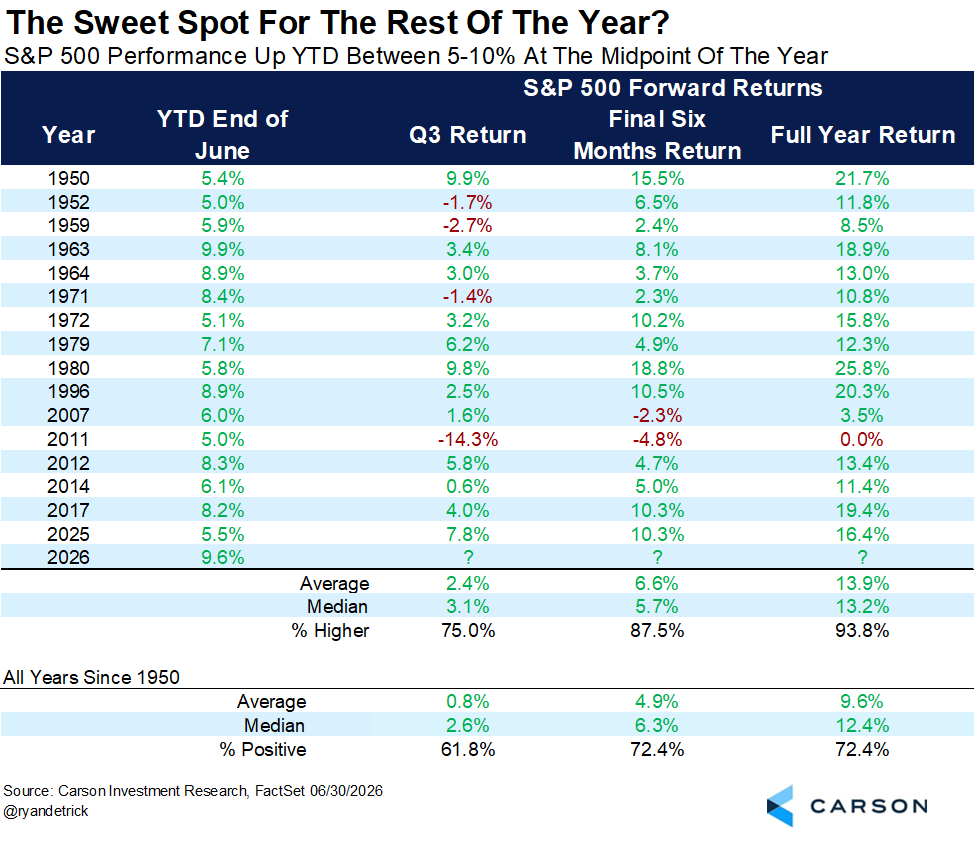
Not too hot. Not too cold.
That doesn't mean we coast. It means we stay diversified, stay disciplined, and resist the urge to let the next scary headline pull us off course.
The Real Risk Isn't What You Think
The biggest risk I see heading into the second half of 2026 isn't a market correction.
It's investors who spent the first half sitting on the sidelines — waiting for certainty that never came — and are now facing a choice between chasing returns or continuing to wait.
Neither is a great option when you've already missed 9.6%.
The news cycle will not get quieter. The Fed will still confuse people. Geopolitics will still be messy. Elections, earnings, interest rates — there will always be something to worry about. That's the deal.
The question is whether your financial plan was built for the world as it is, or for the world you wish existed.
July and Beyond
Historically, July has been one of the strongest months on the calendar for the S&P 500 — higher 11 consecutive years through to recent times, with no month delivering a better average return over the past two decades.
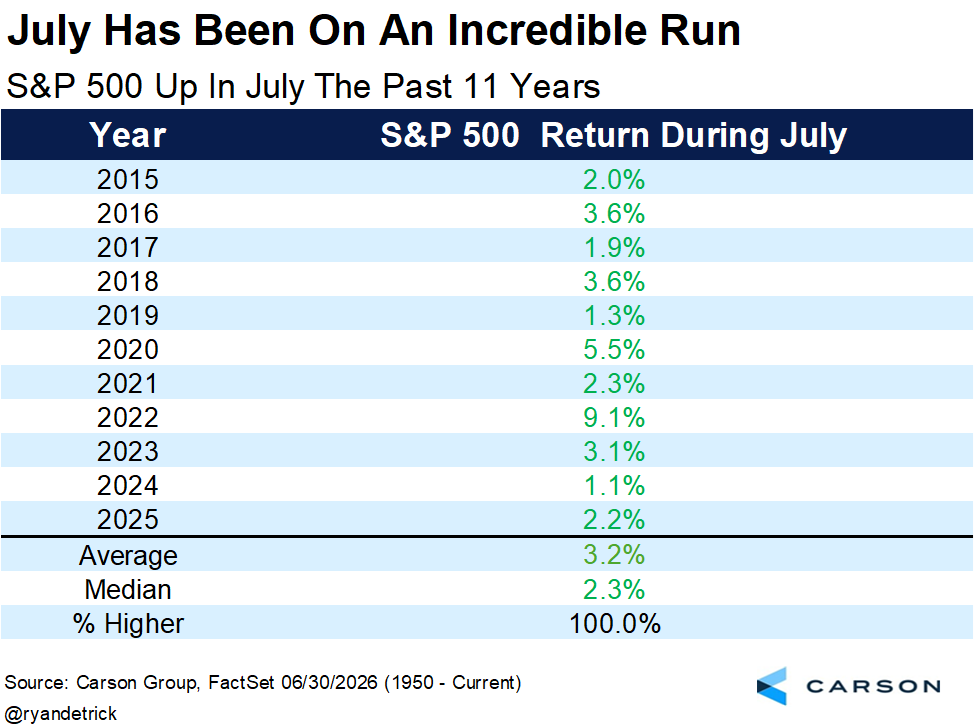
Whether that streak continues, I genuinely don't know.
But I do know this: investors who remained invested through the fear of Q1, through the uncertainty of April and May, are the ones who captured the extraordinary Q2 that followed. That's not luck. That's the reward for having a plan and sticking to it.
The Scoreboard at Half Time
Global markets are resilient. Australian equities are holding up. Fixed income is finding its footing. Volatility has been real, but manageable. And long-term fundamentals remain broadly intact.
Half time is a good moment to review your formation. Not to tear it up — to check it's still fit for purpose.
If your portfolio is properly diversified, aligned to your goals, and you're not taking more risk than you can sleep with — the second half of 2026 looks more interesting than alarming.
And if it's not? That conversation is worth having now, not after the next headline.
Take the long view.
Ready to grow your wealth?
Let's talk. One call. No risk. Just a way to see if we're a good fit.