
October was a bad Month for Tech
The S&P 500 fell 1.13% in October. Nine of eleven sectors rose. Energy, Staples and Utilities each gained more than 10%. The average stock rose 4.8%. Equal-weight had its best month against the index since April 2009.
So where did it hurt?
The (tech) wreck
The Nasdaq 100 fell about 7%. Communication Services fell almost 10%. Alphabet had its worst day since its 2004 IPO, and Intel had its worst day since at least 1974. However, the Dow Jones Industrial Average and the S&P 500 Equal Weight Index were up 1.66% and 4.45% respectively. October was a bad month for tech, but not for the market.

Semiconductors took the worst of it. The Philadelphia Semiconductor Index fell 17.1% in October, its 15th-worst month out of 389 since 1994. On Friday alone it fell 9%, the 13th-worst day out of 8,178.
That comes on top of a July when memory stocks fell nearly 45% and semis fell nearly 30%.
It wasn't the earnings
Of 635 companies reporting so far, 74% beat on earnings. Guidance raises outnumber cuts by more than two to one. In fact, the average stock rose after it reported. Good news is bad news again. It's what happens when a stock, sector, or market gets too crowded.
Here's a fun fact for you: The S&P 500 closed May at 7,580.06. It closed October at 7,580.07. The headline index won't tell you much - during the five months, not much happened. But a lot happened. Beneath the index, the leaders have been sold off hard, while the rest of the market has quietly moved up, and no one's talking about this.
Here's what history tells us
After the Nasdaq 100 has fallen 5% or more in a month, the median return over the next twelve months has been +22.1%. And its higher 73% of the time. The all-months figure is +17.9%, and it's positive 83% of the time. After the semis' 25 worst days, the median gain over the following month has been 5.7%, higher 75% of the time, against 1.8% normally
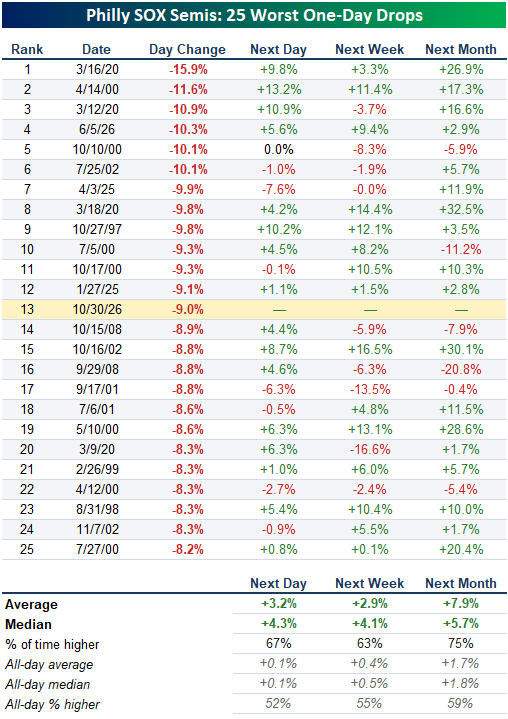
The odds are stacked in the investors' favour. There is however, the fine print.
Twelve of those 25 worst days came between 2000 and 2002. Six were followed by a lower month. And four of the 25 have arrived since January 2025.
The bounce is the base case, but it isn't a guarantee. In the worst episodes, the bounce was the setup for the next leg down.
So what now?
Investors have two reflexes which are on offer: 1) "Buy the dip", or 2) "The bull is dead". Neither however, are analysis. Nor are they a thoughful way of managing one's portfolio. This is gambling, not investing.
The data says big monthly drops are neither a sell signal nor a buy signal. Forward returns after them look much like any other period.
The question isn't whether tech rebounds. It's how much of your portfolio depends on the answer.
October didn't punish diversified investors. It punished the concentrated ones.
Happy Halloween.
Ready to grow your wealth?
Let's talk. One call. No risk. Just a way to see if we're a good fit.